

What Makes a Language ‘Official’ in West Bengal?
The Politics of Recognising 13 Languages — from 1961 to the WBCS Controversy

Setting up the Context
The West Bengal Official Language Act of 1961 set Bangla to be the official language of communication in the state (84% of West Bengal spoke Bangla as per the 1961 Census) with special provision for Nepali to be used in the hilly subdivisions of the districts of Darjeeling, namely Darjeeling, Kurseong and Kalimpong divisions.
Now this act was unsurprising. The districts of Darjeeling, Kurseong and Kalimpong have an identity that is very different to the rest of West Bengal and sought recognition for their cultural identity and language. The West Bengal Official Language Act (1961) addressed the issues of this minority (1.5% of West bengal spoke Nepali as a mother tongue).
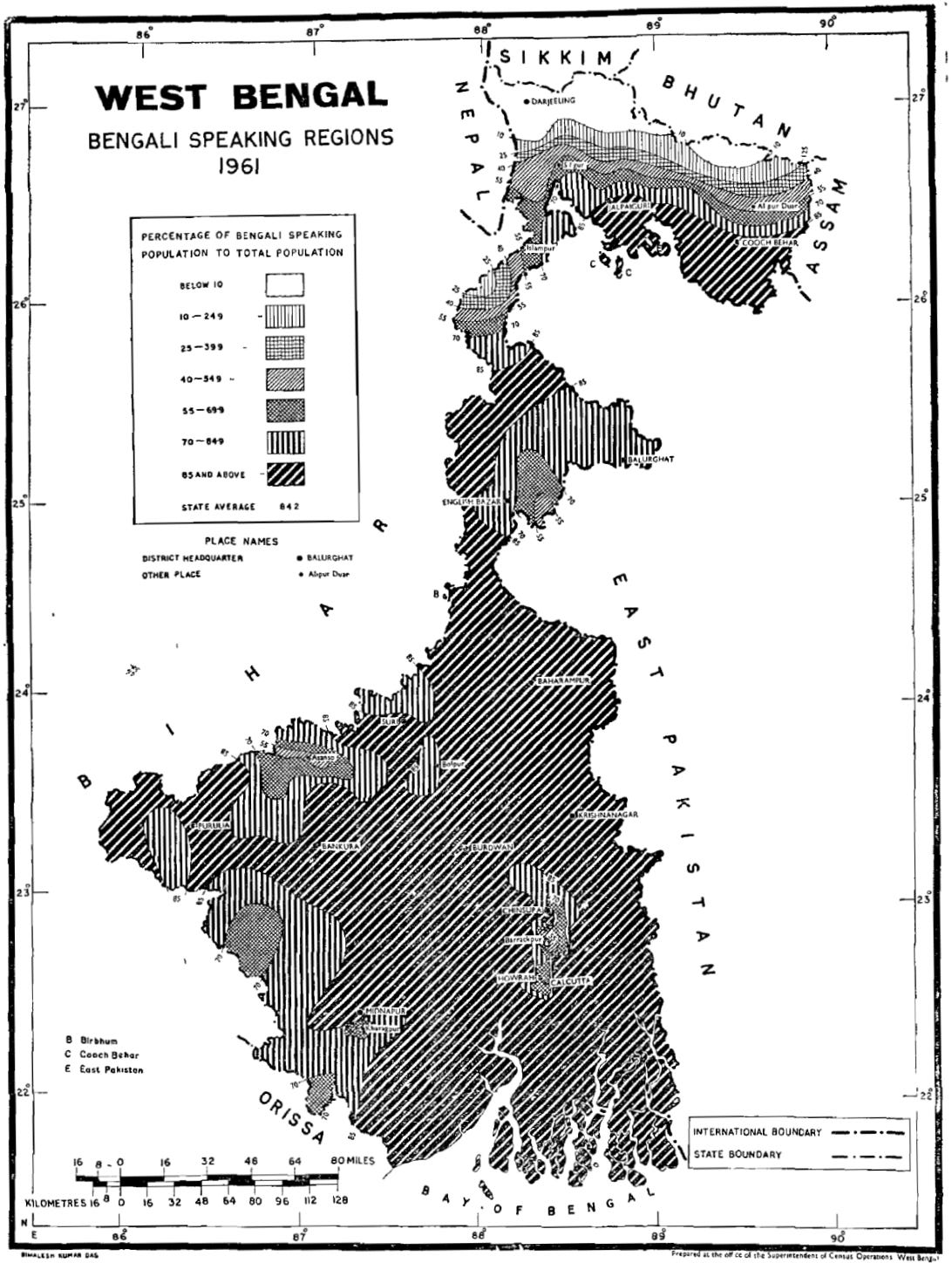
The Map shows the prevalence of Bangla across the state and the lack of it as we approach the North. The Official Language Act of 1961 made sense as per linguistic trends of the time.
What is interesting is the same source mentions how Nepali is the Lingua Franca of the Eastern Himalayas. We shall come back to the “Nepali Invasion” and how it resulted in the decline of the Tibeto Himalayan languages in a future issue.
Where was Hindi in West Bengal?
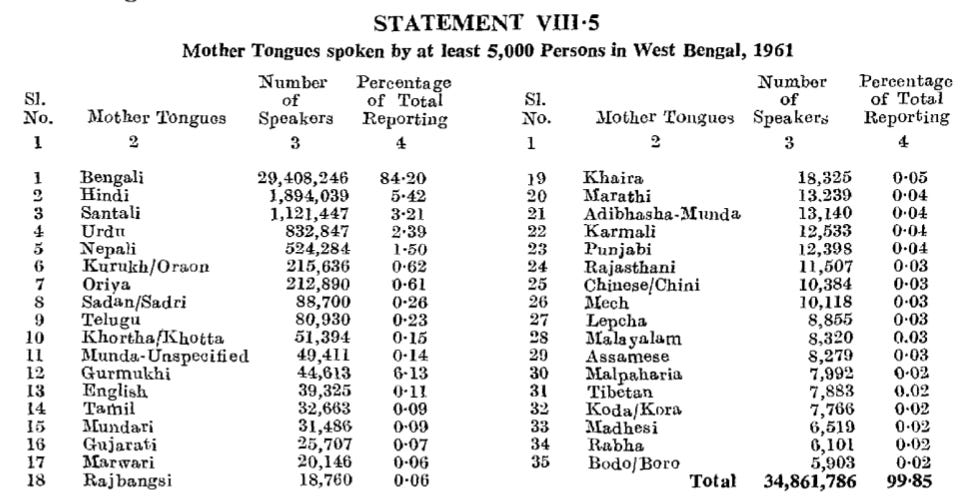
In 1961, 5.42% of people in West Bengal spoke Hindi making it the second most spoken mother tongue in the state however it was not native to the state. It was primarily the language of immigrants as more than twice as many males spoke Hindi as their mother tongue when compared to females. It was actually the second most spoken mother tongue of the time.
Why was Nepali given special status?
Nepali was the fifth-most spoken mother tongue of the time. The third most spoken tongue was actually Santhali (or Santali as per the Official Records) but it was spread over too wide an area for it to be made an official language - the proportion of Santhali speakers was highest in the district of Purulia where only 10% of the population spoke it as a mother tongue. Urdu which was the fourth most spoken mother tongue had a similar story, it was spread over too wide an area and even in West Dinajpur where prevalence of Urdu was the greatest, a mere 10% spoke it.
Comparing these to Nepali, we quickly come to the conclusion that Nepali was concentrated heavily towards the north. More than 59% of the district of Darjeeling spoke Nepali as a mother tongue and more than 70% of the state’s Nepali speakers resided in Darjeeling.
The First Stab
For the 2011 West Bengal State elections, the All India Trinamool Congress (AITC) Party ( commonly referred to as Trinamool Congress or TMC in West Bengal) replaced the frankly archaic Left Front in power. The AITC was (is) headed by Mamata Banerjee and among her first few official decisions as the Chief Minister she added some languages to be the “official second languages” of the state.
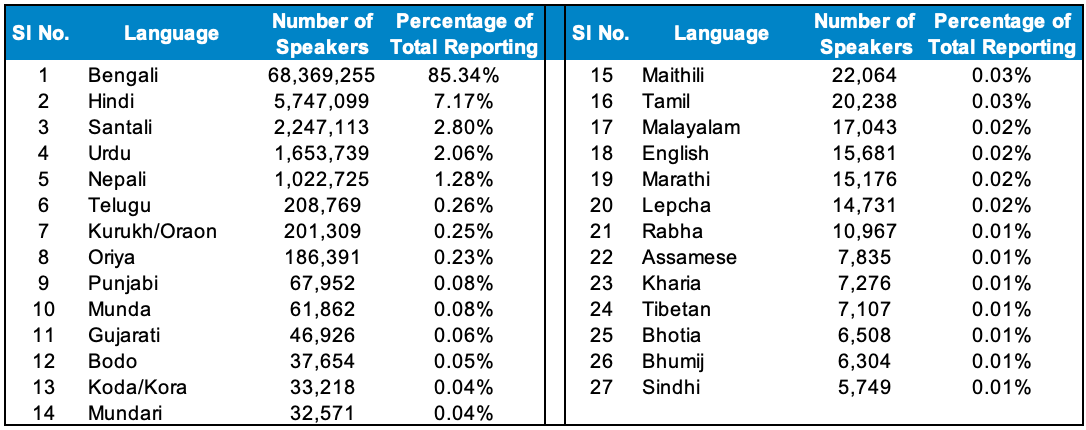
This was made official with the passing of the West Bengal Official Language (Second Amendment) Act (2012), where Urdu, Hindi, Santhali, Oriya and Punjabi were made “official languages” in districts /subdivisions /blocks /municipalities where the speakers of these languages make up more than 10% of the population.
It is important to note that the data used to determine the eligible districts was based on the 2001 Census, as detailed linguistic data was available only for that census at the time. When the Amendment Act was debated and passed, the 2011 Census results had been released only for total population figures, while language data from that census was not published until much later, in 2018.
But let us look at the districts where the official languages would be amended i.e the districts where more than 10% of the population spoke one of Urdu, Hindi, Santhali, Oriya and Punjabi.
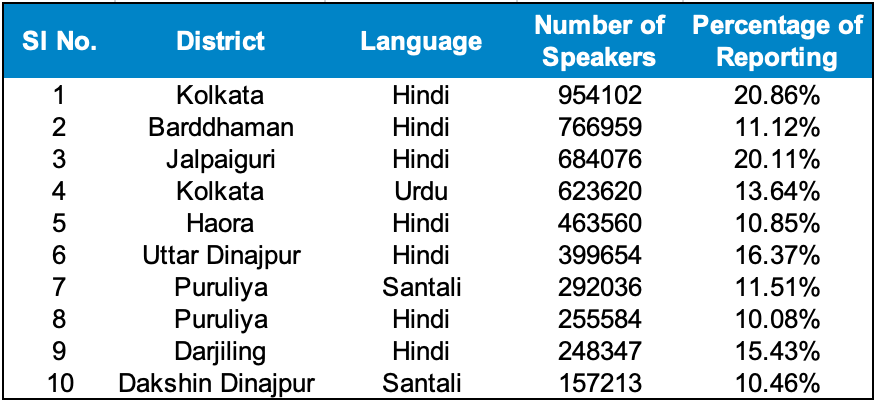
Unsurprisingly, the linguistic landscape of West Bengal changed from 1969 to 2007. A significant share of Hindi speakers had become concentrated in Kolkata, Barddhaman, and Jalpaiguri, while Urdu emerged as the third most spoken mother tongue in Kolkata.
The decision to grant official language status to these languages proved to be a masterstroke by the AITMC.
The Second Stab
The West Bengal Official Language (Second Amendment) Act 2018 was passed to recognise Kamtapuri, Rajbongshi and Kurmali as “official languages” in districts /subdivisions /blocks /municipalities where the speakers of these languages make up more than 10% of the population.
This was controversial due to multiple reasons. Firstly, the 2001 Census — or to be more precise, the 2007 Paper 1: Language: India, States and Union Territories served as the main reference point. Had the state government waited a few more months, it could have drawn on the 2011 Census language data, which was released in the later part of 2018. Secondly, the distinction between language and dialect has always been blurred, specially in the Indian linguistic context. Rajbanshi, for instance, was classified as a dialect of Bangla, Kurmali was treated similarly and reported under two main varieties: Kurmali Thar and Panch Pargania (both under Hindi), and there was no mention of Kamtapuri in the census.
Finally The Politics of It
I haven’t talked about the underlying political nuance of the amendments to the West Bengal Official Language Act (1961) so far as I wanted to talk about the politics separately.
Mamata’s (and the AITC’s) victory in the State Assembly elections of 2011 was strongly backed by the Muslim vote — a community that, during the preceding 34 years of Left Front rule, had repeatedly sought official recognition for Urdu. Incidents like Nandigram further shifted Muslim support toward the AITC (or rather away from the Left Front). Over time, the AITC not only gained strong backing from Muslim voters in South Bengal but steadily consolidated its support across the state, with CSDS surveys showing an increase from 22% in 2006 to 79% in 2021.
AITMC continues to defend the minority appeasement allegations that are thrown at them rather consistently. Zeroing in on the language aspect of politics the Bharatiya Janata Party (BJP) has a serious image issue with its language policies. The persistent hammering of the 3 language formula by them hampers West Bengal’s cultural pluralism and as a result have faced a disconnect with a lot of non-hindi speakers across the rest of India.
However West Bengal (and Jharkhand) have always been posed as interesting challenges. The non-Bengali vote is supposed to lie with BJP however the division of the non-Bengali vote is what actually matters. The Urdu speakers aren’t with BJP but the Hindi vote is. What about Nepali and Santhali? That is where it starts getting more complex.
The demands by the Nepali speaking population of West Bengal to create their own state, ‘Gorkhaland’, was first supported by BJP and then it wasn’t anymore. The demand for Santhali to be made an official language was made a while ago yet as was in the case of Urdu largely unseen by the Left Front until the twilight years of their stranglehold of power in West Bengal.
As I had stated above it was a great political move by AITC to make the first five languages official. What about the rest? The addition of Kamtapuri, Rajbongshi and Kurmali was less of a choice and more of reaction that the AITC was essentially forced into.
The Rajbanshi community in North Bengal, particularly around Cooch Behar, has for decades demanded greater autonomy, including a separate state or “Greater Cooch Behar” - similar to the calls for “Gorkhaland” but these demands were met with indifference by the Left Front . The AITC, in contrast, pledged to provide greater recognition for Rajbongshi language speakers, even as authorities continued to regard it as a dialect rather than a distinct language. However, these pledges weren’t fulfilled and the Rajbongshis were enraged. This disregard marked a significant shift in political allegiance toward the BJP. The move to grant official language status to Rajbanshi, Kurmali, and Kamtapuri was a clear response to the growing threat of losing a substantial share of votes in North Bengal to the BJP. Romita Datta’s piece on India Today (2018) does a good job covering the history of the Rajbongshi language movement and the politics which led to it being made an official language.
The WBCS Fiasco
A recent notification regarding the West Bengal Civil Services (WBCS) exam ignited widespread protests across the state. Aspirants were now required to choose one language paper from a list that included Bangla, Nepali, Santhali, Urdu, and Hindi. While this might have seemed inclusive on the surface, it struck a nerve with language advocacy groups like Bangla Pokkho.
Bangla Pokkho's opposition is rooted in the belief that Hindi and Urdu represent external impositions, politically motivated and culturally alien to Bengal. For them, the inclusion of Hindi and Urdu in official frameworks reflects a broader pattern of “Hindi imperialism”, backed by the Centre, which privileges Hindi-speaking populations in job access, education, and administrative influence.
The movement draws historical parallels from the anti-Urdu struggle in East Pakistan and anti-Hindi agitations in Tamil Nadu. Their concern extends to economic disadvantage: when Hindi is introduced in state exams, it disproportionately benefits Hindi-speaking aspirants from outside the state, while local Bengali-speaking youth are left behind.
Language Advocacy Groups & Assimilation
Language identity needs advocacy. However, I’d argue most language advocacy groups don’t aim for integration; they often push back against assimilation. Take majority language groups across India, their advocacy usually leans more toward imposing their language on others, rather than simply promoting it. On the other hand, minority language groups tend to turn inward, focusing on preserving their language within their own communities.
We can analyse how this plays out with a simplified 2 player game theory like analysis. Let there be a majority side and a minority side.
If both sides coexist, it's a stable, high-payoff equilibrium (language pluralism, functional communication, mutual respect).
If the majority dominates and the minority resists, we hit a low-payoff, conflict-heavy outcome — where neither truly wins (language rights disputes, alienation, voting backlash).
If minorities withdraw, and the majority remains open, there’s still a missed opportunity for meaningful integration.
What if we did not have language advocacy groups at all? Would that mean a conflict free society - frictionless in the linguistic sense?
No, language advocacy groups are necessary and help preserve culture. The lack of language advocacy groups would mean the gradual loss of smaller languages - which would mean we lose different cultures, identity and worldviews.
This piece could easily be extended into a full-fledged research paper by tracking how constituencies with different official languages have voted over time. I’ve chosen not to explore that path here as I did not want this to be an academic deep dive.